
What Does a Custom Home Builder Actually Do?

A custom home builder manages the work involved in turning a home’s design and construction plans into a finished house. Depending on the agreement, this can include reviewing the project scope, coordinating architects and engineers, preparing construction estimates, managing subcontractors, monitoring progress, and organizing the work through completion.
However, hiring a builder does not automatically mean every part of the project is included. Some builders offer design-build services, while others take responsibility for construction after the homeowner has worked with an architect. The contract determines who handles each task, which services are included, and what remains the homeowner’s responsibility.
Understanding the role of a custom home builder can help you ask better questions, compare proposals, and know what to expect before construction begins.
What Does a Custom Home Builder Do?
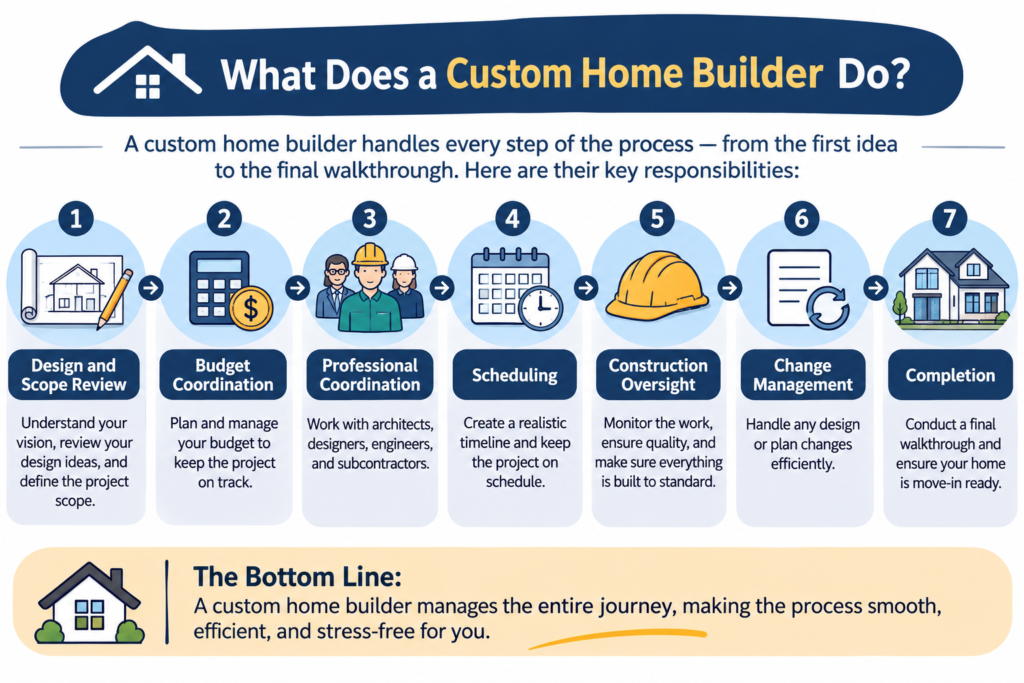
A custom home builder coordinates and manages the construction of a home based on the owner’s requirements, the approved design, the property, and the agreed project scope.
Unlike a project built from a standard plan with limited choices, a custom home may involve individual design decisions, specific material selections, layout changes, and property-related considerations. Someone needs to bring the different parts of that work together.
A builder’s responsibilities commonly include:
- Reviewing the home design, construction plans, and project scope.
- Preparing or coordinating construction estimates.
- Working with architects, engineers, subcontractors, and suppliers.
- Organizing construction activities and material deliveries.
- Developing and monitoring the construction schedule.
- Coordinating site work and monitoring construction progress.
- Communicating about changes, costs, and delays.
- Arranging required inspections and preparing for project completion.
The exact role depends on the services the builder has agreed to provide. Before signing, homeowners should understand which responsibilities are included and which require separate professionals.
What Are the Main Responsibilities of a Custom Home Builder?
The work of a custom home builder extends beyond the physical construction of the house. Much of the responsibility involves planning, coordination, cost management, communication, and keeping different trades working in the right sequence.
1. Reviewing the Home Design and Project Scope
Before construction starts, the builder needs to understand what the project involves.
This means reviewing the available plans, discussing the homeowner’s requirements, identifying the work included in the agreement, and clarifying details that could affect cost, materials, or scheduling.
The builder may also coordinate with the architect and engineers to understand structural requirements, building systems, material specifications, and site conditions. If a design decision creates a construction or budget concern, the builder can raise it with the relevant professionals and discuss possible adjustments with the homeowner.
A clear scope of work is important because it establishes what the finished home is expected to include. It also helps prevent misunderstandings about excluded items, additional work, and responsibilities.
2. Preparing and Managing the Construction Budget
Budget coordination is another important part of a builder’s role.
Depending on the agreement, the builder may prepare an estimate or coordinate pricing for labor, materials, subcontractors, and other construction work. The estimate should explain what is included, what is excluded, and which costs may change as the project develops.
A residential construction budget may account for:
- Site preparation and foundation work.
- Structural construction, framing, and roofing.
- Plumbing, electrical, and HVAC systems.
- Interior finishes, fixtures, and materials.
- Subcontractor labor.
- Applicable permits, inspections, and project fees.
- Other agreed work, such as driveways or landscaping.
Homeowners should not assume that every project-related expense is included in the builder’s estimate. Land, design and engineering fees, financing costs, utility connections, landscaping, and other items may be handled separately depending on the project.
The builder should also explain how the budget will be updated when the scope changes. For example, upgrading flooring, changing fixtures, or revising a room layout may affect material costs, labor, and the construction schedule.
For a broader look at the early decisions involved in organizing a project, read theHow to Start a Construction Project: Step-by-Step Guide.
3. Coordinating Architects, Engineers, Subcontractors, and Suppliers
A custom home requires input from several professionals and construction trades. The builder helps coordinate their work so that each stage can proceed when the preceding work is ready.
Depending on the project, this may involve working with:
- Architects and designers: Develop the home’s design, layouts, and architectural plans.
- Engineers: Address structural and other technical requirements.
- Electricians and plumbers: Install the home’s electrical and plumbing systems.
- HVAC contractors: Handle heating, ventilation, and air-conditioning work.
- Other subcontractors: Complete framing, roofing, insulation, drywall, flooring, painting, and other construction tasks.
- Suppliers: Provide materials, fixtures, and equipment required for the project.
For example, electrical and plumbing work needs to align with the home’s layout and construction sequence. Material deliveries also need to arrive when the relevant work is ready.
The builder’s responsibility is to coordinate the people and activities covered by the agreement. Homeowners should confirm who hires subcontractors, manages supplier arrangements, and communicates with each professional.
4. Creating and Managing the Construction Schedule
A custom home builder typically develops or coordinates a construction schedule and monitors progress against it.
The schedule may cover site preparation, foundation work, framing, roofing, plumbing and electrical installations, interior finishes, inspections, and final completion.
Each stage depends on several factors, including the design, property conditions, approvals, material availability, labor, and completion of earlier work. A delay in one area can affect activities scheduled afterward.
The builder should communicate important milestones and explain when a delay affects the wider project. Weather, material availability, design changes, inspection findings, and unfinished preceding work may all affect the sequence.
A schedule is a planning tool, not a guarantee that every stage will finish on an exact date. Homeowners should understand how updates will be shared and how changes to the schedule will be handled.
5. Overseeing Construction and Monitoring Workmanship
During construction, the builder coordinates site activities and monitors whether work is progressing according to the plans, specifications, and agreement.
This may involve:
- Coordinating subcontractors and construction activities.
- Checking progress against the agreed scope.
- Identifying issues that need attention.
- Communicating site-related decisions to the homeowner.
- Coordinating required inspections.
- Following up on work that needs correction.
The precise quality-control responsibilities should be explained in the agreement. Homeowners should also understand how to raise concerns, who will respond, and how corrective work will be documented.
A builder’s site oversight does not necessarily replace the role of an independent inspector or other professional. If independent inspections are important to the homeowner, that arrangement should be discussed separately.
6. Managing Changes and Unexpected Issues
Changes can arise during a custom home project. A homeowner may want to revise a design detail, a selected material may become unavailable, or a site condition may require further attention.
The builder helps assess how an issue affects the construction work and coordinates with the relevant professionals when a decision is needed.
Before approving a change, the homeowner should understand:
- What is changing and why.
- Whether revised plans or additional approvals are needed.
- How much the additional work will cost.
- Whether the change affects the schedule.
- How the revised scope and price will be documented.
A written change order or another agreed written approval process helps both parties keep track of additional work and its cost implications.
Homeowners should avoid relying on informal conversations alone when a change affects the contract, budget, or construction schedule.
7. Coordinating Inspections and Preparing for Completion
Some construction stages require inspections or approvals under the applicable local requirements. Depending on the agreement and project arrangements, the builder may coordinate access, prepare work for inspection, respond to identified issues, and organize the next stage.
As the home approaches completion, the builder may also coordinate remaining construction work and prepare for handover.
Before considering the project complete, clarify:
- Which inspections or approvals are required.
- What documents or records will be provided.
- How outstanding items will be listed and addressed.
- What warranty information, if any, is included in the agreement.
- Whether maintenance guidance or other handover information will be supplied.
The homeowner should know what completion means under the contract rather than assuming that the final construction activity automatically settles every outstanding responsibility.
What Does a Custom Home Builder Not Usually Do?
A custom home builder may coordinate several parts of a project, but that does not mean every professional service or project expense is automatically included.
Some responsibilities are commonly handled separately:
- Buying the land: The homeowner typically chooses and purchases the property unless a separate arrangement has been made.
- Architectural design: Some builders offer design-build services. Others work with an architect hired separately by the homeowner.
- Engineering: Structural and other engineering services may be provided by separate professionals.
- Financing: Mortgage applications, construction loans, and other financing arrangements are generally separate from the builder’s construction responsibilities.
- Legal and property matters: Title, easements, deed restrictions, and legal advice may require a real estate or legal professional.
- Independent inspections: Homeowners may choose to hire independent inspectors in addition to inspections required by the relevant authorities.
- Work outside the contract: Landscaping, fencing, appliances, utility connections, or other items may be excluded unless they are specifically included in the agreement.
These are not universal exclusions. A builder may take responsibility for some of these services through a wider agreement or by coordinating separate professionals. The important point is to confirm what is included rather than assume.
How Is a Custom Home Builder Different From an Architect, Engineer, or Project Manager?
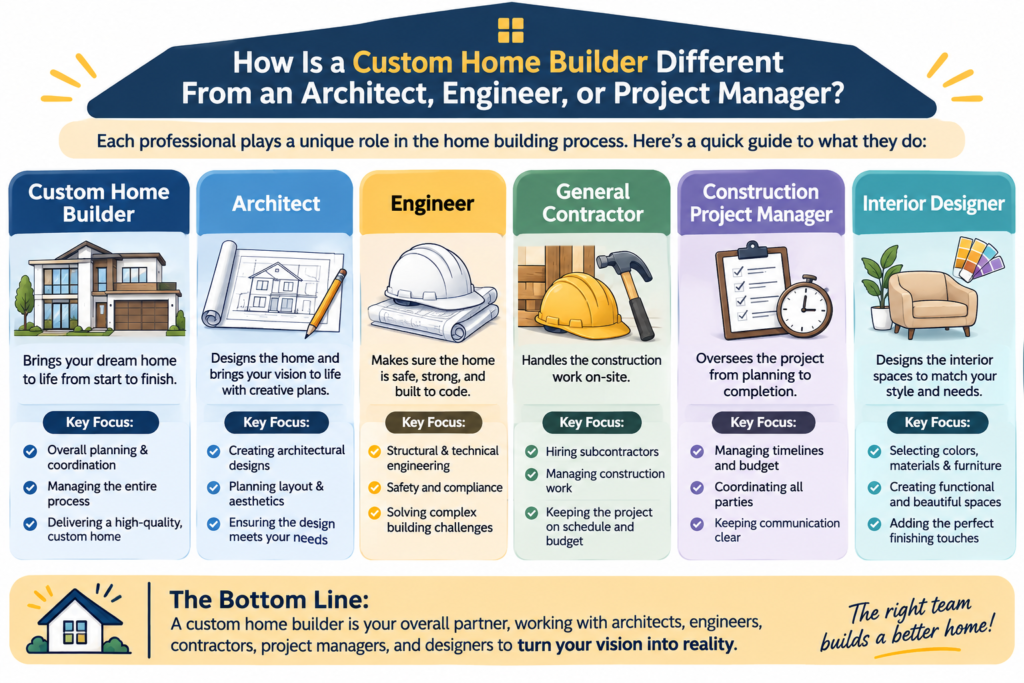
These professionals may work together on the same home, but their roles are different. One company or professional may also take on more than one role, depending on the project arrangement.
| Professional | Main responsibility |
| Custom home builder | Coordinates and carries out the agreed home construction work, including site activities, subcontractors, scheduling, and construction coordination as defined in the agreement. |
| Architect | Develops the architectural design and plans. The architect’s additional services may include design coordination or construction-phase observations. |
| Engineer | Provides technical design and analysis for specific areas, such as structural components or other building systems. |
| General contractor | Manages construction work under a contract. A custom home builder may perform this role on a residential project. |
| Construction project manager | Coordinates planning, budget, schedule, communication, and project delivery according to the scope of their appointment. |
The distinction matters because homeowners need to know who is accountable for each part of the work. Before construction begins, confirm who handles design, engineering, permitting, subcontractor coordination, site oversight, communication, and handover.
For a closer look at how planning, scheduling, budget coordination, and communication fit together across a project, see the construction project management service.
When Should You Hire a Custom Home Builder?
The right time to involve a builder depends on the project and the services you need.
If you are still exploring a property, design, or budget, speaking with a builder early may help you understand construction considerations before making major commitments. Some builders can contribute during pre-construction, while others prefer to begin after the homeowner has completed the design and plans.
Consider speaking with a builder when:
- You own land or are considering purchasing a property for a new home.
- You want to understand how your design may affect construction costs.
- You need to discuss the practical requirements of building your proposed home.
- You want to understand how subcontractors, materials, and site activities will be coordinated.
- You are preparing to compare construction proposals.
- You want to clarify responsibilities before signing an agreement.
If you are still working through the overall homebuilding journey, How to Build a Custom Home: A Step-by-Step Guide explains the broader process from planning and design through construction and completion.
For Texas specific preparation, including considerations that may affect a residential project in the state, see How to Build a House in Texas: What to Know Before You Start
These guides cover the wider building process and regional preparation. This article focuses specifically on the builder’s responsibilities within that process.
What Should You Ask a Custom Home Builder Before Hiring One?
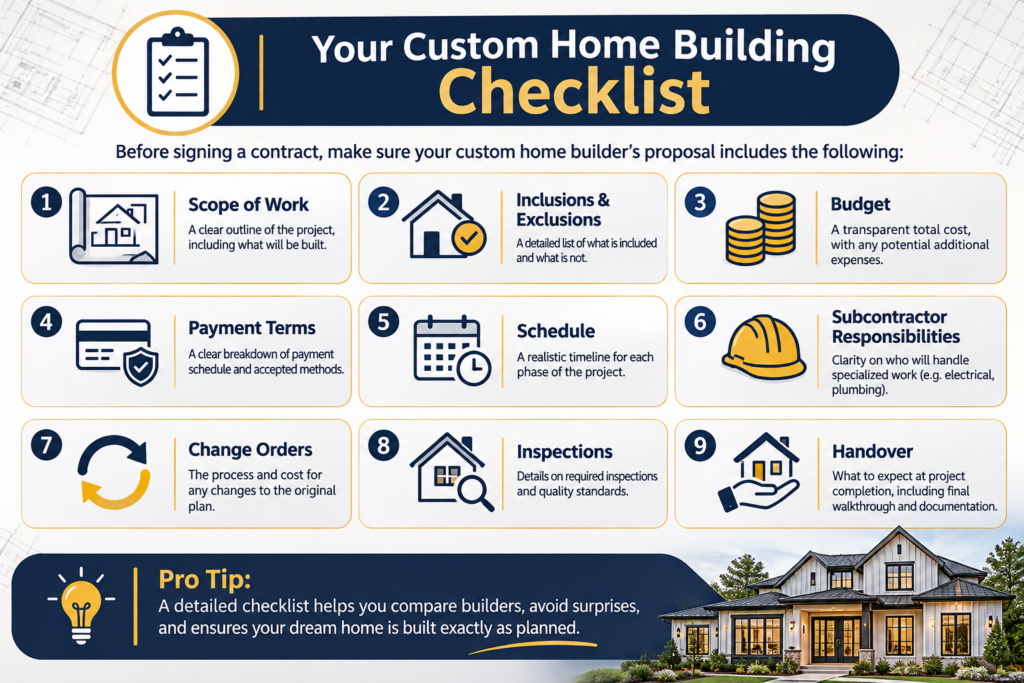
Before signing an agreement, ask questions that help you understand what the builder will manage, how the work will be organized, and how decisions will be handled.
Useful questions include:
- What services are included in the agreement? Ask for a clear description of the builder’s responsibilities and any excluded work.
- Will you coordinate with the architect and engineers? Confirm who communicates with the design and technical professionals.
- How will the construction estimate be prepared and updated? Ask what the estimate includes and how changes in pricing will be handled.
- How are allowances, upgrades, and changes priced? Understand the approval process before additional work begins.
- Who hires and coordinates subcontractors? Clarify who manages trade contractors and material deliveries.
- How will I receive progress updates? Agree on how often updates will be provided and who your main contact will be.
- What is the proposed construction schedule? Ask which milestones are included and what conditions could affect the schedule.
- Who coordinates required inspections? Confirm who prepares the work, arranges access, and follows up on inspection findings.
- How are construction concerns and corrective work handled? Understand how issues are reported and resolved.
- What documents will I receive at handover? Ask about completion records, outstanding items, and any warranty or maintenance information included in the agreement.
Ask for important responsibilities and arrangements to be documented. Clear written terms make it easier to understand what each party has agreed to do.
How Do You Know If a Custom Home Builder Is Right for Your Project?
A suitable builder should be able to explain the proposed scope, the construction process, the responsibilities of the project team, and how costs and changes will be managed.
When comparing builders, look beyond the initial estimate. Consider:
- Whether the proposed work matches your project requirements.
- Whether the written scope clearly explains inclusions and exclusions.
- Whether the estimate is understandable and sufficiently detailed.
- How the builder communicates about costs, progress, and decisions.
- How subcontractors and materials will be coordinated.
- Whether the proposed schedule explains important milestones and dependencies.
- Whether the agreement explains how changes and problems will be handled.
- Whether references and relevant experience can be reviewed.
The right arrangement depends on the support you need. If you expect one team to coordinate design, budgeting, approvals, construction, and handover, make sure those responsibilities are explicitly covered. Do not assume that a service is included simply because it is related to building a home.
Frequently Asked Questions
What is the main job of a custom home builder?
A custom home builder coordinates the construction of a home according to the agreed design, scope, budget, and schedule. The work may include managing subcontractors, organizing materials, monitoring progress, communicating changes, and coordinating inspections and handover.
Does a custom home builder help with design?
Some custom home builders offer design-build services or coordinate with architects and designers. Others begin construction after the homeowner has completed the design with separate professionals. Ask which design-related services are included before signing an agreement.
Does a custom home builder handle permits?
A builder may coordinate permit applications and required inspections, but responsibilities vary by project and local requirements. Confirm who prepares documents, submits applications, pays applicable fees, and arranges inspections.
Is a custom home builder the same as a general contractor?
The roles can overlap. A custom home builder may act as the general contractor on a residential project, managing subcontractors and construction activities. The exact responsibilities depend on the agreement.
Does the builder manage the entire construction budget?
Not necessarily. A builder may prepare or coordinate estimates for the agreed construction work and communicate changes that affect costs. Homeowners should confirm which expenses are included, which are separate, and how additional work is approved.
Can I hire a custom home builder before I have finished the house plans?
That depends on the builder’s services. Some builders can contribute during early planning or work through a design-build arrangement. Others require completed plans before preparing a construction proposal.
What should be included in a custom home builder’s contract?
The agreement should clearly describe the scope of work, responsibilities, pricing or payment arrangements, exclusions, schedule information, procedures for changes, and how completion and outstanding work will be handled. The details will vary by project.
Discuss Your Custom Home Project With Venus Builders
A custom home builder does more than arrange construction activities. The role can involve coordinating professionals, managing subcontractors, organizing schedules, monitoring progress, and helping homeowners understand decisions that affect the work.
Before hiring a builder, make sure you understand the scope of the agreement, which services are included, how changes will be handled, and who is responsible for each stage.
Venus Builders provides residential construction services for custom-home and new-home projects. If you are exploring a project in Texas, visit the Venus Builders Residential Construction page to learn more about the service and discuss the next steps for your home.